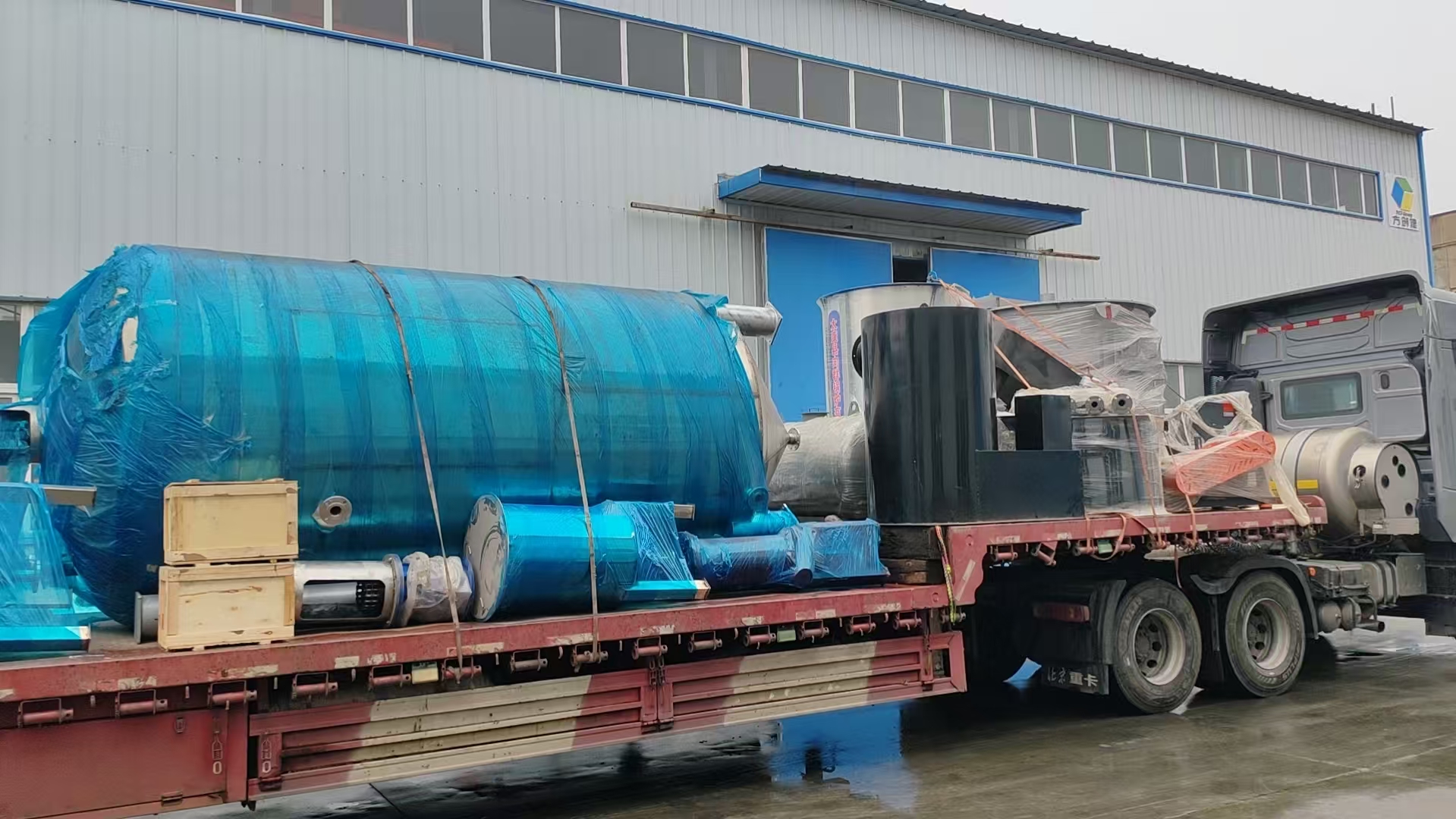
20 TPD Physical Refining Line Shipped to Afghanistan
What Is on the Truck
Three groups of equipment make up the load.
- Process vessels. The deodorizer and bleacher arrived at the loading bay already mounted on their frames, wrapped in three layers of blue protective film and lashed to the flatbed at eight points. The film is not cosmetic: it keeps grinding dust out of the packing during a road leg that crosses several borders.
- Rotating equipment. Vacuum pumps, transfer pumps and the thermal fluid circulation set were crated separately, each crate stencilled with a position number that matches the layout drawing.
- Piping and instrumentation. Flanged spools, valves and the control cabinet shipped loose but bundled by system, so the site crew can unpack by loop rather than by crate.
Why Ship in Modules, Not as One Machine
A refinery of this size cannot travel as a single welded unit. Site welding of thin stainless shells in a dusty inland yard is the most common cause of leaks in the first year of operation. Pre-assembling on skids moves that critical work back into a controlled workshop, where it can be pressure-tested before it ever leaves.
It also matches the transport reality: each module is sized to sit on a standard lowbed trailer and to be lifted by whatever crane the destination yard actually has, not by the crane we would prefer.
Physical Refining and Chemical Refining: Where They Diverge
Both routes remove free fatty acids. They differ in how.
Chemical refining neutralises FFA with caustic soda, then washes the soap out with water. Physical refining skips the caustic entirely and strips the FFA as a vapour inside the deodorizer, under deep vacuum and direct steam.
| Chemical refining | Physical refining | |
|---|---|---|
| FFA removal | Caustic neutralisation | Steam stripping under vacuum |
| Consumables | Caustic, process water | Steam, thermal energy |
| By-product | Soapstock, hard to sell | FFA distillate, saleable |
| Refining loss | Higher | Lower |
| Wastewater | Significant | Minimal |
Which Oils Suit Physical Refining
The deciding factor is not FFA level. It is gum content after degumming. Oils that degum cleanly — sunflower, well-degummed soybean, rapeseed, palm — can go straight to physical refining and keep more of their yield.
Which Oils Should Stay on Chemical Refining
Oils carrying high phosphatides or waxes — cottonseed, rice bran, and poorly degummed seed oils — will foul a physical deodorizer. The gums bake onto the packing and the vacuum collapses. For those feedstocks, chemical refining is not the old-fashioned option; it is the correct one.
For this project the feedstock is REPLACE-OIL, which is why the line was specified as physical.
Why This Configuration Suits a Landlocked Market
Power and Steam Have to Be Solved Locally
An inland plant cannot assume a stable grid. The electrical package was specified so the line can run from a generator set as well as from mains supply, with soft starters on the larger motors to keep the starting current inside what a genset can deliver. The thermal fluid heater is independent of the refining train, so a boiler outage stops production without damaging the oil sitting in the deodorizer.
Spares Decide Whether the Plant Keeps Running
A spare part that takes six weeks to arrive is a six-week shutdown. The shipment therefore carries a commissioning spares kit — gaskets, seals, sight glasses, a spare vacuum pump mechanical seal and the instruments most likely to fail — and the mechanical design uses standard flange and seal sizes rather than proprietary ones, so replacements can be sourced regionally.
The Route Sets the Module Size
Modules were dimensioned against the tightest leg of the journey, not against the workshop door. Oversized vessels are the single most common reason a refinery sits at a border for weeks waiting for a permit or a heavier crane.
From Drawing Approval to Loading
- Engineering freeze. P&ID, layout and utility schedule signed off against the site's actual power and steam supply.
- Fabrication and assembly. Vessels built and skid-mounted in the workshop.
- Factory acceptance test. Hydro-test on vessels, run test on pumps and the vacuum system, control logic checked against the sequence.
- Packing. Film wrap on vessels, crates for rotating equipment, position numbers matched to the layout drawing.
- Loading and dispatch. Lashed, photographed and documented against the packing list.
This unit ran REPLACE-LEAD days from drawing approval to loading.
Frequently Asked Questions
What is the difference between physical and chemical refining?
Physical refining removes free fatty acids by steam stripping inside the deodorizer under vacuum. Chemical refining removes them with caustic soda and then washes out the soap. Physical refining uses no caustic and produces almost no wastewater, but it requires oil that has been properly degummed first.
How much oil can a 20 TPD refinery process per day?
Twenty tonnes of crude oil per 24 hours at nominal capacity. Real throughput depends on feedstock: oil with high gums or high FFA will slow the line, and the achievable refining loss will be higher than the design figure.
Can the line run on a generator instead of grid power?
Yes, provided the electrical package is specified for it. The larger motors need soft starters or variable frequency drives so the starting current stays within the generator's capacity, and the control cabinet must be built for the voltage actually available on site.
What happens after the equipment arrives?
Installation follows the layout drawing shipped with the crates, supervised remotely or on site depending on the contract. Commissioning runs the line on the customer's own feedstock before handover, because a refinery that performs on test oil and not on real oil has not been commissioned.
Planning a Refining Project?
Send us the feedstock, the target capacity per day and the power available on site. We will tell you whether physical refining is the right route for that oil — including when it is not.